Fix Thick, Thin or Drifting Oat Milk: Enzyme Troubleshooting for the Plant Floor
Thick, slimy, watery or batch-to-batch drifting oat base is almost never one enzyme at the wrong dose. The slime that operators blame on "too little amylase" is mostly beta-glucan, a soluble oat fibre that a food scientist describes as polymerising "like crazy" once shear and heat pull it out of the cell matrix. Amylase turns oat starch into maltose, which makes the base sweeter and thinner, but it does not touch beta-glucan. So a base that is still thick after liquefaction needs a beta-glucan lever and a filtration check, not a bigger amylase dose. This page walks through what each enzyme actually does in an oat slurry, the temperature and hold numbers practitioners get wrong, a symptom-to-lever table, and what to ask a supplier before a trial. Every enzyme named here is available for wholesale and bulk supply to manufacturers and resellers, quoted per order.
Wholesale and bulk supply. Enzymesboost supplies alpha-amylase, beta-amylase and beta-glucanase to oat beverage manufacturers, resellers and biotech companies. Pricing and supply terms are quoted per order. To get a quote, send the product, the quantity and the destination country through the inquiry form.
Thick is two different problems: starch and beta-glucan
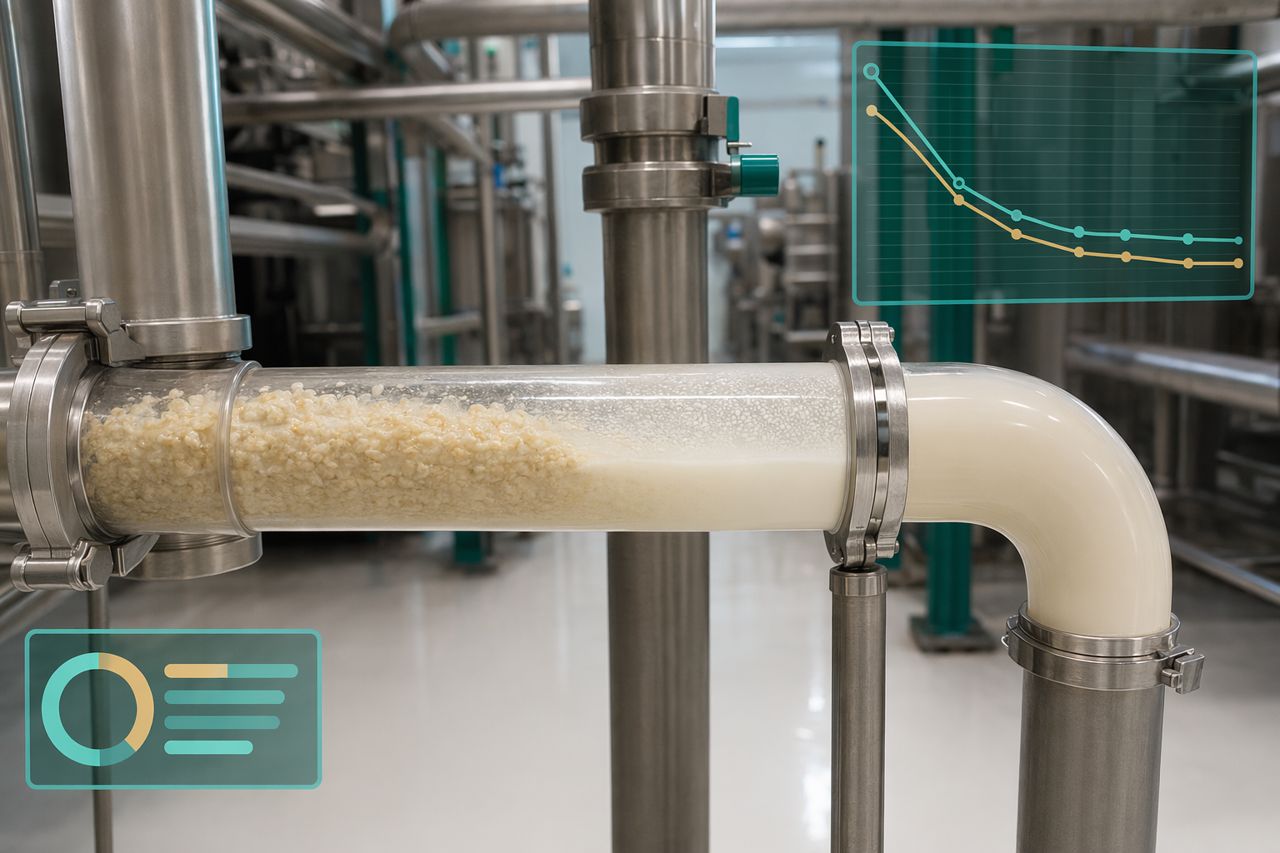
Over-blending and blender heat release more beta-glucan, which is why home makers who switch to ice-cold water and add a few ice cubes report zero slime even at high speed. One widely shared tip is to freeze the oats for about 1 hour before blending, again to keep the slurry cold. A plant cannot run cold, because starch has to gelatinise before any amylase can reach it, so the plant version of this lesson is: control shear, control the time the slurry spends hot before the enzyme is in, and treat beta-glucan as its own variable. A cook-blend of only 25-30 seconds with cold water comes out non-slimy every time for one regular maker, which shows how much of the viscosity is mechanical before any enzyme is involved. Soaking and rinsing the oats also washes part of the beta-glucan out, which is why a soak step can look like an enzyme effect when it is not. Rinsing soaked oats and blending only for a few seconds is the same trick reported from another kitchen. In a factory you do not rinse, you hydrolyse: a beta-glucanase added before separation lowers the beta-glucan viscosity and the filter or decanter load that comes with it.
Three enzymes, three jobs: do not confuse them
Alpha-amylase cuts large sections out of the starch chain in the middle; the beta or gluco enzyme snips the ends off and releases the small, fermentable sugars. A brewer in that discussion thread wrote that glucoamylase "is beta amylase" before starting an oat project, and that confusion costs plants real money because the two enzymes need different temperatures and give different sugar profiles. Beta-amylase from natural sources works at 55-60 C and pH 5.0-5.5, while engineered variants stay stable at 70-75 C and pH 4.0-4.5. In starch-sugar plants beta-amylase takes maltose content above 75%, and with pullulanase added it reaches 85% or more, so it is the sweetness tool, not the viscosity tool. The beta-amylase level in a grain lot also changes with the growing climate, which is one reason the same recipe behaves differently on a new oat delivery. Commercial oat drinks get their sweetness from enzyme tanks that turn starch into maltose, and the same step removes some of the sliminess.
| Symptom in the tank | Most likely cause | Enzyme lever | What to check first |
|---|---|---|---|
| Gel-like after the hold | starch not gelatinised before the enzyme, plus beta-glucan load | cook to a paste first, then alpha-amylase, then beta-glucanase | hold temperature actually reached before dosing |
| Thin or watery after storage | enzyme never stopped, starch kept breaking down | heat stop (boil or pasteuriser) right after the hold | time between end of hold and heat step |
| Slow filtration, decanter overload | beta-glucan viscosity, not starch | beta-glucanase before separation, cold shear control | shear and heat in the blend step |
| No sweetness, flat taste | starch not converted to maltose | alpha-amylase first, then beta-amylase in the 55-60 C window | hold temperature and pH 5.0-5.5 |
| Batch drift on a new oat lot | lot enzyme profile, hydration, dosing temperature | add enzyme only after set temperature, track oat lot | pitch temperature log and lot number |
The hold step: the numbers that go wrong
A home recipe that copies the industrial process heats the oat-water slurry to 145 F (63 C), holds it 15 minutes with stirring, and optionally flash-boils at the end to deactivate the enzyme. The most useful comment under that video says to "pitch" the amylase only after reaching 145 F, and if you overshoot, wait for it to cool first instead of throwing the batch away. Heat destroys the enzyme shape and that damage cannot be undone, whereas cooling only pauses activity, so overshooting before dosing is worse than undershooting. The failure case from another recipe shows what happens without water control: the oats absorbed all the water before the slurry reached 140, boiling then dried it out, and the first strain gave almost nothing. The creator of that recipe admits he cut the key step from his video: bring the mixture to a boil after the rest, because only the boil kills the enzyme and ends the starch breakdown. Without that stop the base keeps thinning in the tank and in the carton. A viewer there uses alpha-amylase precisely because it tolerates heat, which is also why thermostable alpha-amylase is the plant's liquefaction choice and beta-amylase is not.
Grain starch that is hard to convert follows the same logic: cook to a paste, let alpha-amylase thin it randomly, then let the beta or gluco enzyme chop off glucose. One brewer's protocol for rice was to boil for an hour, add alpha at 160 F, hold 60 minutes at 150-160 F, and add beta only when the mash cooled to 100 F. Rice gelatinises above normal boiling, so pressure cooking was suggested to unlock the starch, and the same gelatinisation check applies to coarse oat flour. If your oat flour is not fully gelatinised when the enzyme goes in, the conversion will look random and the base stays heavy no matter the dose.
Dose: what the kitchen numbers tell you and what to ask for at plant scale
The household reference point is 1 digestive capsule of roughly 8,000 DU amylase per 1 cup of rolled oats in 4 cups of water, blended 20-30 seconds before the heat step. The other working recipe uses 1/2 gram of an amylase product (about 2 tablets) on 100 grams of oats in 2 cups cold water, then 4 cups of ice-cold water, with 1 gram xanthan, a little lecithin and 23 grams oil for the barista version. A plant does not buy capsules: industrial beta-amylase is sold at around 700,000 U/g, packed from 1 kg trial sizes to 25 kg drums and 1000 kg IBCs, with a minimum order starting at 1 kg. Pure beta-amylase is less common as a standalone catalogue item than alpha-amylase or glucoamylase-amylase blends, which drive conversion more aggressively, so ask for the exact enzyme, not "amylase". Beta-amylase also comes in plain 1 kg packs with a better tier from 25 units, which is how most plants sample before committing to a drum. Beta-glucanase is offered for 40-55 C and pH 3.5-5.5, with a 12-month shelf life, in 1 kg or 25 kg packs.
What the order book says: most buyers take the 700,000 U/g powder and often add alpha-amylase or glucoamylase, which is the alpha-then-beta sequence described above. Beta-glucanase buyers split between a 13,000 U/g brewing liquid and a powder, and most pair it with cellulase or pectinase rather than with amylase. Dosage figures on those sheets appear in several different units, so a dose without a unit and a basis (per kg of oats or per kg of solids) is useless for scale-up.
Troubleshooting list, in the order to check
- Log the temperature at the moment the enzyme goes in; if it was not at 145 F (63 C) or your validated set point, that run is not a dosing problem.
- Check the water-to-oat ratio before heating; oats that soak up the water before 140 give almost no first strain and a dried-out, slimy residue.
- Confirm the heat stop happened within minutes of the end of the hold; a base that thins in storage was never stopped, and an unstopped home batch keeps only 1 or 2 days.
- Measure shear: a 25-30 second blend in cold water is non-slimy where a long hot blend is not, so a recirculation loop or a hot high-shear mixer can create the slime you then try to enzyme away.
- Run a no-enzyme control batch from the same oat lot with only 3 ingredients; if it is slimy too, the beta-glucan side needs beta-glucanase, not more amylase.
- Check the oat lot: a new delivery with a different enzyme profile changes conversion at the same dose.
- Check gelatinisation of the flour before dosing, because incomplete cooking leaves starch the alpha-amylase cannot reach; only then adjust the amylase dose, and adjust sweetness with beta-amylase in its 55-60 C, pH 5.0-5.5 window after the alpha step, never instead of it.
Mistakes we see repeated
Home makers list their two mistakes as warm water and squeezing the bag, and both have a plant twin: a slurry held hot without enzyme, and a filter pushed too hard so fines and beta-glucan pass. A blender set too high over-blends and a cloth too coarse under-filters; the same person found the result depends on blender power and cloth thickness, which in a plant means mill setting and filter mesh. Homemade oat milk without a heat step keeps only 1 or 2 days in the fridge, a reminder that enzyme activity and microbial load both continue if the stop is skipped. Treating glucoamylase and beta-amylase as the same product gives glucose instead of maltose and a different sweetness. Expecting the enzyme to fix slime that came from shear and heat leads to overdosing amylase and a watery base. Measuring success by gravity or refractive index in a slurry full of fibre is unreliable; a glucose test strip was the practical suggestion for a quick conversion check. Oat milk at 4-5 day consumption cycles is the home scale; a plant that wants weeks of shelf life has to stop the enzyme and pasteurise, which is why the hold-then-heat sequence is not optional.
What to ask a supplier before the trial
Ask which enzyme it is, by name: alpha-amylase for liquefaction, beta-glucanase for viscosity and filtration, beta-amylase or glucoamylase for sweetness. Ask for the activity unit and the activity figure, for example 700,000 U/g for beta-amylase, and for the temperature and pH range the activity was measured at. Ask for the inactivation temperature, because your heat stop has to beat it. Ask for the pack sizes: 1 kg for a trial, 25 kg drum for production, 1000 kg IBC for a liquid at volume. Ask whether the product is a pure enzyme or a blend with glucoamylase, because blends attenuate harder and will thin a base faster than you planned.
Get a troubleshooting plan and a quote
Send Enzymesboost your symptom (thick, thin, slow filter or drift), the oat lot, the hold temperature and the hold time through the inquiry form, and ask for a trial plan with a trial-size sample of the matching enzyme: alpha-amylase, beta-glucanase or a maltose booster. If you only need a spec sheet with activity, temperature and pH ranges to compare against your current product, ask for that instead.
For a quote, add the product, the quantity (trial amount or production volume) and the destination country. Pricing and supply terms are quoted per order, and we reply with the dosing window to test first.