Sediment, Grittiness, and Particle Control in Oat Milk
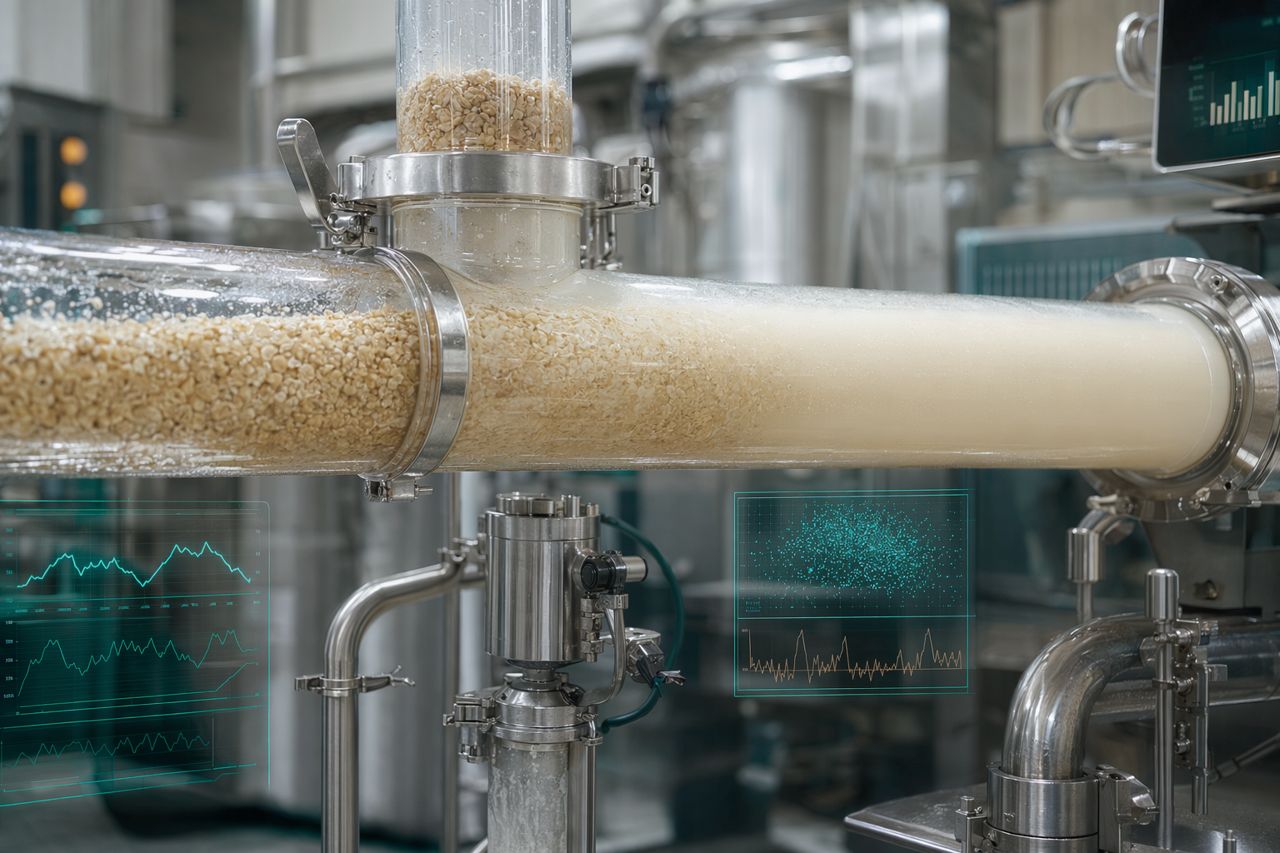
For an oat milk factory, sediment is not just a visual defect. It is a process signal. Grittiness, settling, slow filtration, uneven mouthfeel, and operator troubleshooting usually point to the same core issue: particle load is not being controlled consistently through milling, hydration, enzymatic conversion, separation, and final standardization.
Enzymesboost works as an enzyme supplier for oat milk production with a clear focus on plant-floor performance: predictable viscosity, cleaner separation, stable throughput, and a smoother finished drink.
Why sediment shows up in oat milk
Oats bring starch, beta-glucan, protein, lipids, fiber, and mineral-rich insoluble material into the process. When those fractions are not converted, dispersed, or removed in a controlled way, they can carry through into the finished beverage.
Common causes include:
- Coarse or inconsistent milling, leaving large particles that resist hydration and separation
- Incomplete starch breakdown, creating heavy particles and unstable mouthfeel
- Over-conversion, which can thin the system too far and reduce body
- High beta-glucan viscosity, slowing flow and trapping insoluble solids
- Variable oat lots, where fiber, starch, and hydration behavior shift from batch to batch
- Separation overload, forcing decanters, screens, or filtration stages to manage more solids than intended
- Thermal history drift, where heat-up, hold, and cooling behavior alter enzyme performance and particle structure
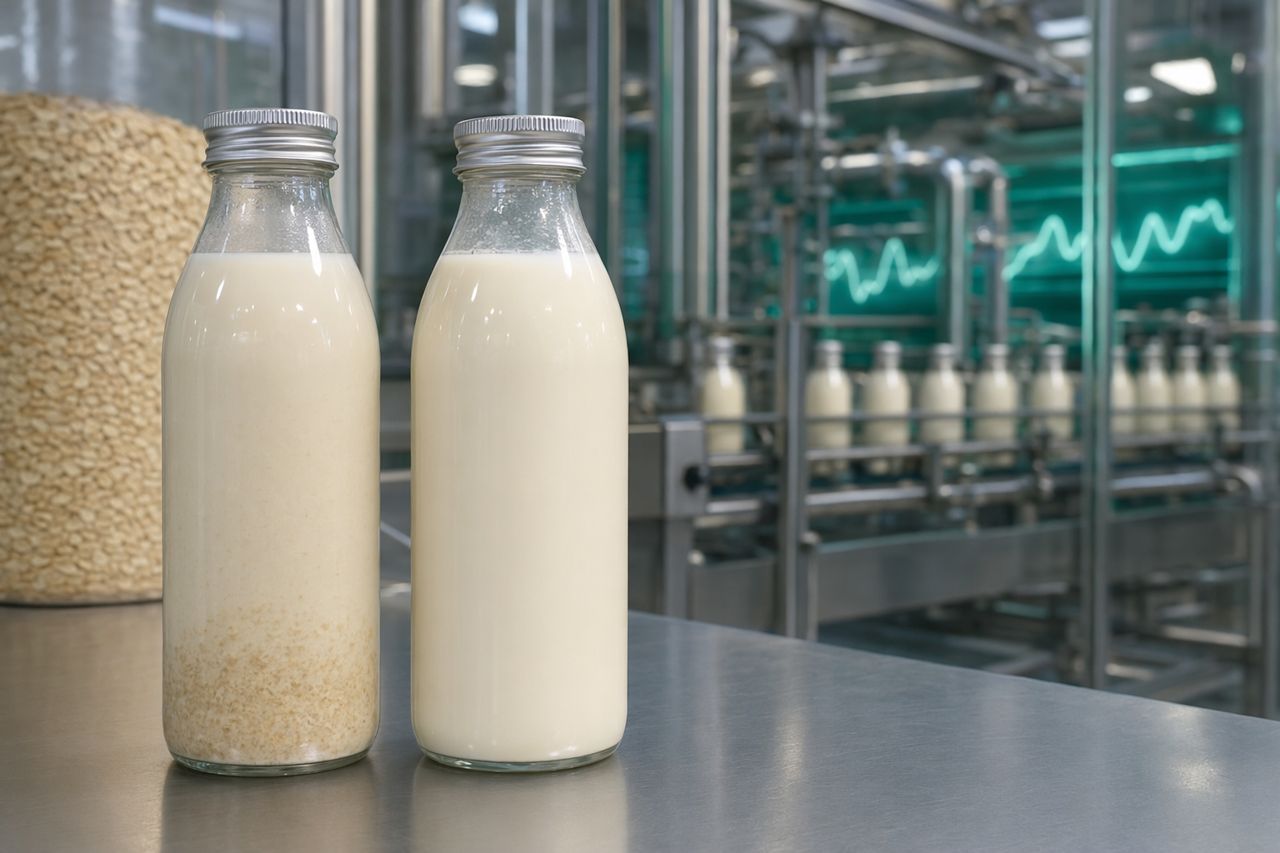
The visible result may be a layer at the bottom of the bottle. The operational result is usually more costly: longer runs, slower clarification, more rework decisions, more sensory checks, and less confidence at release.
Grittiness is a mouthfeel problem and a control problem
Consumers describe grittiness as rough, chalky, sandy, or grainy. In production language, it is often a combination of oversized particles, insufficiently hydrated oat solids, and insoluble fractions that remain suspended long enough to pass downstream but settle later in storage.
A smooth oat milk does not need to feel thin. The commercial target is controlled creaminess: enough body to support a dairy-like experience, without heavy sediment, pasty viscosity, or unstable suspension.
That balance depends on how well the process controls three linked variables:
- Particle size distribution — what remains after milling, hydration, enzymatic treatment, and separation
- Viscosity profile — how the slurry behaves during pumping, heat treatment, holding, separation, and blending
- Conversion endpoint — how far starch and soluble fibers are modified to support flow, sweetness balance, and mouthfeel
Where enzymes help in particle control
Enzymes are not a cosmetic fix for sediment. Used correctly, they become a control tool inside the oat milk process.
Enzymesboost enzyme systems can be selected to support:
- Viscosity reduction before separation, helping solids move more predictably through the line
- Improved slurry flow, reducing hold-ups in tanks, piping, heat exchangers, and filtration stages
- Cleaner starch conversion, limiting pasty texture and unstable particulate carryover
- Beta-glucan management, reducing drag while protecting the round texture expected from oat beverages
- Batch-to-batch consistency, especially when oat lots vary in composition or hydration behavior
- More reliable downstream filtration, with fewer sudden pressure rises and less operator intervention
The objective is not simply to make the slurry thinner. The objective is to make it controllable.
Process areas to review when sediment increases
When sediment or grittiness rises, the issue is often handled at the end of the line. A better approach is to examine where the particle burden is being created.
1. Milling and hydration
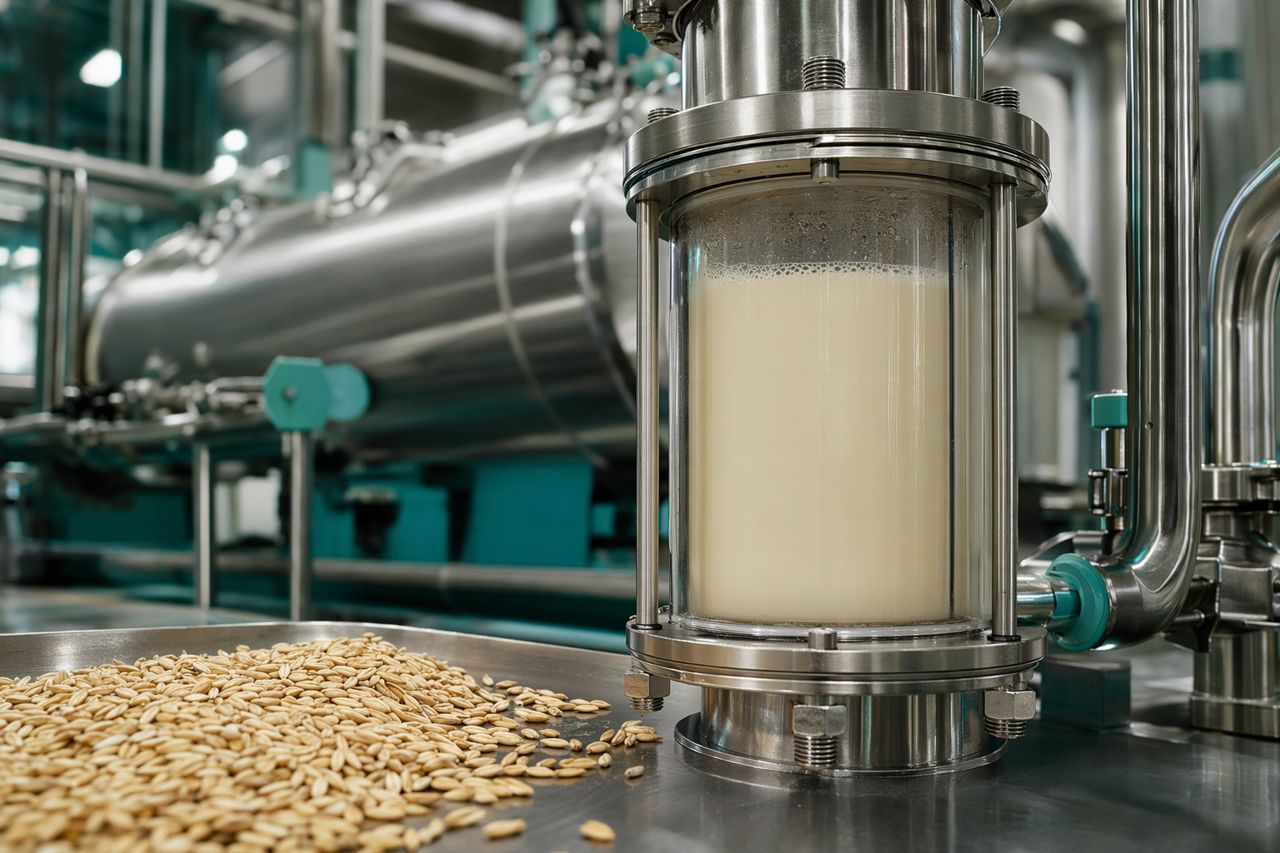
If particles enter the enzyme stage unevenly hydrated, conversion can become uneven. Some fractions break down quickly, while others remain dense and resistant. This can create a finished beverage that looks acceptable after processing but develops settling during storage.
Review:
- Oat particle uniformity before hydration
- Wetting and mixing efficiency
- Hydration time consistency
- Slurry temperature stability before enzyme addition
- Dead zones in mixing tanks or transfer lines
2. Enzymatic conversion window
The enzyme step must match the factory’s thermal profile, residence time, mixing pattern, and target mouthfeel. A mismatch can create either high-viscosity slurry that separates poorly or over-thinned material that lacks creamy structure.
Review:
- Addition point and mixing intensity
- Actual heat-up behavior, not only setpoints
- Residence time variation between batch sizes or continuous runs
- Conversion endpoint used by production and quality teams
- Interaction between amylase activity, beta-glucan reduction, and final texture
3. Separation and filtration load
If viscosity stays high, separation equipment may carry more fine solids forward. If conversion is uneven, a mixed particle population can challenge screens, decanters, separators, or filtration systems.
Review:
- Feed consistency into separation
- Solids load variation across the run
- Filtration pressure trends
- Backflush or cleaning frequency
- Sediment behavior after storage simulation
4. Heat treatment and stabilization
Thermal processing can change mouthfeel and suspension behavior. If the upstream enzyme profile is not aligned with the final heat process, sediment risk can reappear after the product looks stable in the process tank.
Review:
- Viscosity before and after heat treatment
- Particle behavior after cooling
- Texture shift during holding
- Sediment development over shelf-life checks
- Compatibility with stabilizers, if used
What Enzymesboost brings to oat milk factories
Enzymesboost supplies enzyme systems for oat milk production with a practical view of factory performance. We focus on how the enzyme choice affects throughput, separation, filtration, mouthfeel, and release confidence.
Our approach is built around questions process managers actually face:
- Can the line run at target flow without viscosity spikes?
- Does the slurry separate cleanly without overloading filtration?
- Is the finished drink smooth, creamy, and stable enough for the brand standard?
- Can production handle variation in oat lots without constant adjustment?
- Are operators spending less time troubleshooting sediment, grit, and inconsistent texture?
Enzyme selection priorities for sediment reduction
For oat milk, enzyme selection should be guided by the factory’s process reality, not a generic ingredient list.
Key selection factors include:
- Thermal fit — the enzyme system must perform within the plant’s actual heating and holding pattern
- Viscosity target — reduction must support flow while preserving desired body
- Conversion control — starch modification should reach a repeatable endpoint without drifting into thin or overly sweet profiles
- Separation support — the treated slurry should feed downstream equipment with a more manageable solids profile
- Sensory protection — the final beverage should remain clean, creamy, and free from chalky or grainy notes
- Operational tolerance — the solution should remain robust across normal raw-material variation
Signs your enzyme program needs review
It may be time to reassess the enzyme system if your plant is seeing:
- Sediment forming in bottles after release checks
- Gritty or chalky mouthfeel despite acceptable appearance
- Slow filtration or rising pressure during production
- Batch-to-batch viscosity swings
- Separation losses that vary with oat lot
- Operators compensating with extra dilution, longer holds, or repeated adjustments
- Finished product that is either too heavy and pasty or too thin and watery
These symptoms often appear as quality issues, but the root cause may sit earlier in the conversion and particle-control strategy.
Building a more stable oat milk process
Sediment control is strongest when enzyme use is integrated with milling, hydration, thermal treatment, and separation. Enzymesboost helps factories align those process points so the final product has the intended body without unwanted grit or settling.
The commercial value is straightforward:
- More consistent batches
- Better filtration performance
- Reduced troubleshooting
- Improved line confidence
- Cleaner mouthfeel
- Lower risk of quality holds tied to visible sediment or texture complaints
Request a quote
If sediment, grittiness, viscosity drift, or filtration load is affecting your oat milk line, Enzymesboost can help you evaluate an enzyme approach built for production.
Request a quote and tell us about your oat base, process window, separation setup, and target texture.